.png)
.png)
.png)
.png)

Karo Sambhav collaborates with leading organisations to jointly develop industry frameworks, standards, governance mechanisms, systems and processes that advance the transition to circular economy. know more about our alliances.

Close x

There is something almost effortless about the way we experience artificial intelligence today. A question is answered within seconds, an image appears with a simple description, and complex tasks that once required hours can now be completed instantly. While these interactions often appear entirely digital, they rely on a significant physical infrastructure, including data centres, servers, and electronic hardware that enable AI technologies to function. Understanding this underlying infrastructure helps reveal the broader environmental and resource implications of AI.
The Short Life of AI Hardware
Every AI model depends on a vast physical infrastructure of servers, data centres, and specialised hardware. Thousands of advanced chips operate continuously to process information and deliver the experiences we associate with AI. While conversations around artificial intelligence often focus on its capabilities, another question is beginning to emerge: what happens to the hardware that powers AI when it reaches the end of its life?
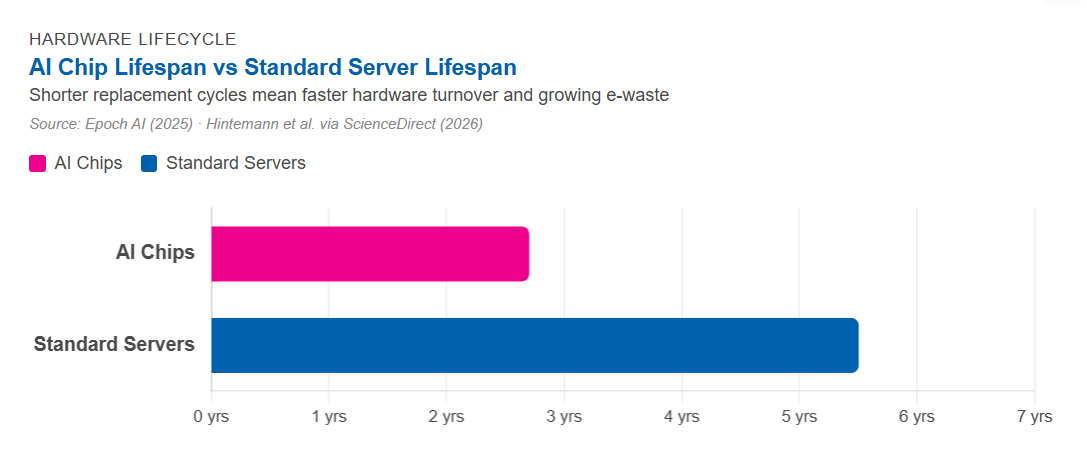
The lifecycle of AI hardware is shorter than many realise. The rapid pace of technological advancement means that even powerful chips can become outdated within a few years, not because they stop working, but because newer generations offer improved performance and efficiency. Research from Epoch AI (2025) estimates that leading AI chips remain in use for a median of around four years before being phased out of frontier AI training, with that figure dropping closer to 2.7 years when older chip generations are included. This constant replacement cycle may lead to a growing stream of electronic waste.
The scale of this challenge is expected to increase as AI adoption expands. A 2024 study published in Nature Computational Science projected that generative AI could contribute between 1.2 and 5 million tonnes of e-waste by 2030. Though it's worth noting that more recent research has suggested this kind of early estimate may overstate the true figure, since it's hard to predict exactly how fast hardware will turn over. (Source: Nature Computational Science, 2024)
The challenge is also visible within data centres themselves. An industry-wide report by Supermicro found that 43% of data centres surveyed did not have an environmental policy for managing e-waste, while 12% reported no recycling practices at all and more recent industry surveys suggest these gaps persist, with a large share of operators still not tracking what happens to their hardware once it's retired (Source: Supermicro Data Centers & The Environment Report). As AI infrastructure grows, responsible end-of-life management becomes an increasingly important part of the technology lifecycle.
The Solutions Already Taking Shape
However, the future does not have to follow a simple pattern of producing, using, and discarding. Circular approaches are beginning to reshape how AI hardware is managed. Extending hardware utilisation through shared computing models, improving refurbishment systems, and designing equipment with recovery in mind can help reduce unnecessary waste. AI itself can also contribute to improving recycling processes, from identifying materials more efficiently to supporting better sorting and recovery methods. Research from McKinsey and the Ellen MacArthur Foundation suggests that AI applications in the circular economy for consumer electronics could unlock up to $90 billion in value annually by 2030. (Source: McKinsey / EllenMacArthur Foundation)
Some organisations are already exploring more circular approaches. Microsoft's Circular Centers programme reported a 90.9% reuse and recycling rate for server components in 2024, demonstrating that large-scale technology infrastructure can move towards more responsible resource management. (Source: Microsoft, 2024)
The story of AI is often told through innovation, speed, and possibility. But every digital experience has a physical foundation behind it. As artificial intelligence continues to grow, the question is not only how advanced these systems become, but how thoughtfully we manage the materials that make them possible.
The opportunity to create a more circular AI ecosystem still exists. The decisions made today, in how hardware is designed, used, extended, and recovered will determine whether the future of intelligence is also a future built on responsibility.
Karo Sambhav collaborates with leading organisations to jointly develop industry frameworks, standards, governance mechanisms, systems and processes that advance the transition to circular economy. know more about our alliances.